Saturday, 15 August 2015

History in a Bigger Office: August in Cairngorm & Spey.

Having met (just) a book deadline for the end of July, I began August with a few days reading for pleasure - catching up on new outdoors writing & naturalism. I’d patched up my old Westwind tent (so damaged by blizzards in 2009 that I'd considered it a write off) & spent a couple of nights out amongst trees not far from the back door…
…clambering up into them seemed ideal for reading books like Oliver Rackham’s The Ash Tree.
But this couldn’t go on long: two work-related things needed doing in earnest. I had to catch up with some challenging writing on the experience of time (reading I’ve been putting off for a while) and to reconceptualise a historical project about the 1890s that has been coming together (and falling apart again) for two years.

This kind of thinking – which needs to shift established habits of thought but also embed itself deep in the memory – demands dramatically new surroundings: it's aided by unique images & atmospheres that become bound up with particular trains of thought. So I packed myself a mini-library (formed around the vast granite massif of Francois Hartog’s Regimes of Historicity: Presentism and Experiences of Time, but including some poetic outliers too)…
…and set off North. 

In the summer, days outdoors work wonderfully for intensive thinking. With 16+ hours of light & no distractions but sky, crag & creature, it’s possible to intersperse 10 hours walking with 8 reading. And walking must surely be the best thinking time there is: it’s no surprise, I guess, that ideas formed while moving slowly through geological & ecological drama just seem to stick deeper & burn brighter than ideas made at the same small desk that’s forever associated with daily routines.

This habit began fifteen years ago when I was a student. Back then it was partly a response to lack of private space; when I had time to travel I’d head into the most secluded spots I could find, often in the Rhinogs or the Dark Peak, with a bag of books. These were usually on a single theme – the cultures of Late Antiquity, early-medieval Scandinavia or the visual arts in the early twentieth century – and I’d stay & read for as many days as I could make my food last. 

It took a little longer (until I had more by way of resources) to get further afield. But soon I could indulge extraordinary luxuries: to get deliberately lost for several days in Fisherfield (with writing about ancient Sumer) or ensconce myself for a glorious September week on Rum (with books about George Eliot & a copy of Middlemarch). Thinking about those landscapes now leads to involuntarily recollection of precisely what I read there, and many of the books that have been most formative of my historical thinking were carried on these trips. Here's a book by John Berger, over breakfast on Foinaven:
The venue for this week’s thinking was dictated by weather: the Cairngorms were the only Scottish range with a good chance of cloud-free peaks. This is one of the highland regions I know least well. That's partly because it’s on the way to my favourite places: I’ve long feared that if I develop an affection for Cairngorm, it’ll take the edge off my thirst for the far NW & I’ll get lazy: stopping after 6 ½ hours instead of 8 ½, settling for round-ridged Ben Macdui instead of the serrations of Torridon. For years I even refused to buy the map, telling myself (I hate to admit!) that the Cairngorms, like the Lake District & the music of Arnold Bax, are for my 50s. 

So this trip was a departure. It coincided with the perseid meteor shower & a new moon: a perfect time to be out under the stars. I’d also decided to break the habit of spending mountain nights in just a sleeping bag (in case I was forced to sleep among the midgies) so this was an outing for my lovely old Terra Nova bivi bag - after 7 yrs no longer waterproof but still cosy. Arriving at Linn of Dee mid-afternoon I set off up Glen Lui and through the pine forests of Glenn Laoigh Bheag, full of ancient fallen trunks…
…then made my way onto Carn a’ Mhaim.
Tall enough to guarantee freedom from the August midge-plague, this provided a great spot to sit on rocks, lean back on my rucksack & dig deep into books. I read Hartog as the clouds turned slowly pink, with stunning views in all directions.
By sunset, though, the cloud cover was consistent: no perseids tonight.
Next day would be exactly what I’d been craving: a span of unbroken reading-walking. This kind of craving - fixating on outdoors thinking time - doesn’t seem to be unusual among historians. Some of it, I guess, is down to the old connections between history, antiquarianism & archaeology. It's intruiging, for instance, that a formative moment in Kathleen Jamie's career in landscape writing (recounted in the chapter of Sightlines entitled ‘The Woman in the Field’) came when volunteering on an archaeological dig: Jamie’s prose conjures how the lives of many who interpret the past are tied to places that are now sparsely populated. There are illustrations from the beginning of the modern history boom too: Walter Scott wrote one novel - The Antiquary - that's more intricate & ambitious than any of his others. It's full of characters representing different kinds of historical interests & different aspects of Scottish society, with a tramping chief protagonist who tries - and fails - to comprehend historically the land he lives on. One of the first texts I ask my second-year history students to read is a 1966 essay by Keith Thomas. He criticises his peers for assessing things 'by feel rather than by figures' but the way he expresses this is telling: he says that the computer must replace ‘the “stout boots” worn by the advanced historians of the past generation’.

The stout-booted writers Thomas had in mind surely included George Macaulay Trevelyan (right), perhaps the most celebrated of all hill-walking historians. 
Trevelyan created histories – which he thought of as primarily imaginative things - while he wandered the fells of northern England. And Trevelyan was one of the first historians I ever read for leisure. On a family visit to South Wales, aged about 13, I used my holiday spending money to buy (for some unfathomable, fateful reason) a copy of Trevelyan’s 1926 History of England that happened to be in a tiny bookshop in St Brides. I had no real idea what it was (I'm not sure I even registered that it might not be cutting edge). But discovering that this book had been conceptualised while walking Hadrian’s Wall gave it enormous appeal to me.

At that age I couldn't see the complete worldview that lay behind Trevelyan’s expertly-told narratives & informed his outdoors pursuits. For him, landscape was a religion, scenery a site of pilgrimage & walking a form of worship. He was fond of phrases like ‘sacred union with nature’ & supported causes like the Pilgrims Trust & Outward Bound as a kind of crusade against urban life. He was the first president of the Youth Hostel Association (their headquarters is still called Trevelyan House). Writing mainly in the interwar years, Trevelyan had been profoundly unsettled by the connections between modern technology, social change & war. This - added to a deep distrust of religion - led him to pursue a new kind of creed: ruralism was inseparable from his literary romanticism & liberal vision of history. What I failed to pick up as a teenager was the profoundly disturbing English exceptionalism & mystic nationalism that lay behind all this. Weighed down with assumptions of imperial destiny & fear of national decline, Trevelyan hoped that ‘natural beauty’ would ensure that ‘the English people’ didn’t ‘perish in the spiritual sense’. 

So Trevelyan has lived with me for a long time, as a reason for wanting to do history &, later in my teens, as a source of the realisation that all history is ideological, never morally neutral or non-partisan. Whenever I see really old fashioned walking boots, his is the name that pops into my head. And his less nationalistic writing still does make far better reading than the texts of his contemporaries – many of whom made their history utterly dry in futile pursuit of scientific professional status.
  
As the sun came up on the following morning, everything was engulfed in cloud. I walked onto the ridge that leads to Scotland’s second highest mountain, Ben Macdui, and stopped for the day’s first read. Rich, early-morning light had begun to break through & a better, airier reading spot would be hard to imagine. 
As I looked down at the gleaming white walls of Corrour bothy (above) I thought of Trevelyan, who would surely have been wildly enthusiastic about what the Mountain Bothies Association do (for more on that see this book by Phoebe Smith, which has been getting lots of good BBC coverage recently). The beginnings of the River Dee:
Once onto Ben Macdui itself, every reading stop brought hordes of inquisitive snowbuntings (hordes is no exaggeration). These were perfectly willing to pose for photos, and showed a remarkable range of different summer plumage, some adapted strikingly well for camouflage among Cairngorm boulders.
From Macdui, apparent patterns in cloud formation could be identified, banks clinging to the western & southern sides of the plateau. One mountain in particular seemed to stay clear of all of this: Beinn Mheadhoin. Topped by looming granite torrs (the Barns of Beinn Mheadhoin), this seemed like a wonderful place to spend tonight, so I began to make my way across via a circuitous tour of corries, full of sub-Alpine flora & fauna, that are the real glory of the Cairngorms. These are the sites of crystaline streams whose praises Nan Sheppard sang in The Living Mountain (a must-read for any Cairngorms visitor).
Even at the lowest points of today’s walking, snow fields were plentiful.
And glorious reading spots, looking out towards the evening’s target, were easily found:
This was by far the best walking of the trip – perfect conditions, verdure underfoot, ever-changing scenery, and total solitude. Plus Ptarmigan:
I investigated Carn Etchachan & Castlegates Gully before climbing down the waterfall to Loch Etchachan & beginning the last slog up Stacan Dubha, then the Bheinn itself. 

The summit provided plenty more opportunity to read/think history…
 ...but as the sun set, clouds were amassing on both the western & southern horizons. My perseid views seemed threatened once again. 

I needn’t have worried. What followed was a perfect star-gazing night, in which the milky way stood out against the sky & several meteors per-minute crossed my field of vision, with no need to close the bivi bag all night. This was one of the best nights I’ve spent on the hills recently, the only drawback being the guilt every time I allowed my eyes to close. Only when the sun rose (bivi in mid-ground)...

...did I discover what had happened to all that encroaching cloud. The atmospheric spectacle continued below…
The walk back towards Derry lodge and the Linn of Dee would be a long one, but down some of the E highlands’ most beautiful glens:
This left time for just one more venture before home, but a weather front was pushing north: clouds were beginning to veil most tops & heavy rain was promised. After weighing up several options I decided that, since I’d driven all the way up here with a boat on the car, I probably ought to use it. The canoeist’s (and whisky drinker’s) paradise of the River Spey was just a few miles away, providing low-level views of the Cairngorms, and passing through several hotspots of avian & aquatic life. After a quiet night in Kingussie, I drove to Kincraig, pushed off into Loch Insh & headed upstream. With a different kind of beauty from the plateau above – serene after the bleakness – this stretch of the Spey is lined with lichenous alders & passerine-filled willows...
...many of which are veterans, with all the splits, rot & fractures that turn a tree into a habitat.
 
Moths & butterflies, dragonflies, spiders & warblers abounded, flitting through the William Morris wallpaper...
...and the water itself was alive with minnows, water beetles & water boatmen – this felt more vigorous & teeming with creatures than the rivers - Severn & Wye - near home. When I pulled up on a shingle beach beneath a stand of Scott’s Pines, I left a wagtail to guard the boat... 
...and climbed the bank to read for a while. Flocks of lapwings passed, as did a surprising array of birds of prey, one particular young buzzard making an outlandish racket as it tried to draw food from reluctant parents. A little later, the sparrowhawk hidden in these branches snatched a long-tail from the willows and settled down to eat:
Over four days I'd got through around 450 pages of tightly-packed history & scribbled pages of ideas triggered [thanks Ben] by what I'd read: it had all felt like a different kind of work from what I'd do in the office, but a very valuable one.  It's interesting that an increasing number of outdoorsish historians seem to be finding ways to blend their two interests. Helen MacDonald, author of H is for Hawk might be the most celebrated example, but Matthew Kelly's recent & wonderful Quartz & Feldspar: Dartmoor - A British Landscape in Modern Times provides another model. From a different generation, Jonathan Parry (whose whole career has been formed around nineteenth-century religion & politics) now turns to write in earnest the history of mountaineering he's been talking about for decades. Once the current projects are done, perhaps I should try to find myself a topic... 

Leaving the highlands or islands always feels bad, this time more so because the stay had been so short & uncompromised by adverse weather. But leaving was less agonising knowing I’ll be working like this for most of September, housed in a beautiful cottage on the banks of Loch Torridon, Shieldaig pub just a short row across the water. Can’t wait:
 

Sunday, 19 July 2015

Great Dim Seas of Gabro Waves: Peaks & Peninsulas of Skye


Suddenly, in early July, an unlikely gap appeared in Llinos's diary (as an orchestral musician, she rarely gets more than a couple of days free till late summer): we rushed to book a room on Skye. Diverse & sprawling, Scotland's largest island offers a glorious combination of exceptional landscapes, a 360-mile coastline & great places to make merry through grim weather. This week the forecast was mixed: Tuesday seemed kayak-friendly, but otherwise rain & wind aplenty. 

Another reason for us to choose Skye was that our first holiday together, 14 years ago (after our 1st yr at University), was a camping trip here. Though I've been back many times, that was Llinos' only visit till now. Here are pics of our teenage selves wandering the island at the start of the century (can't quite believe I'm posting these!!):
 
There was no need for us to have worried about weather this time. By some obscure miracle, not a drop of rain or gust of unwelcome wind arrived until the morning we set off home.

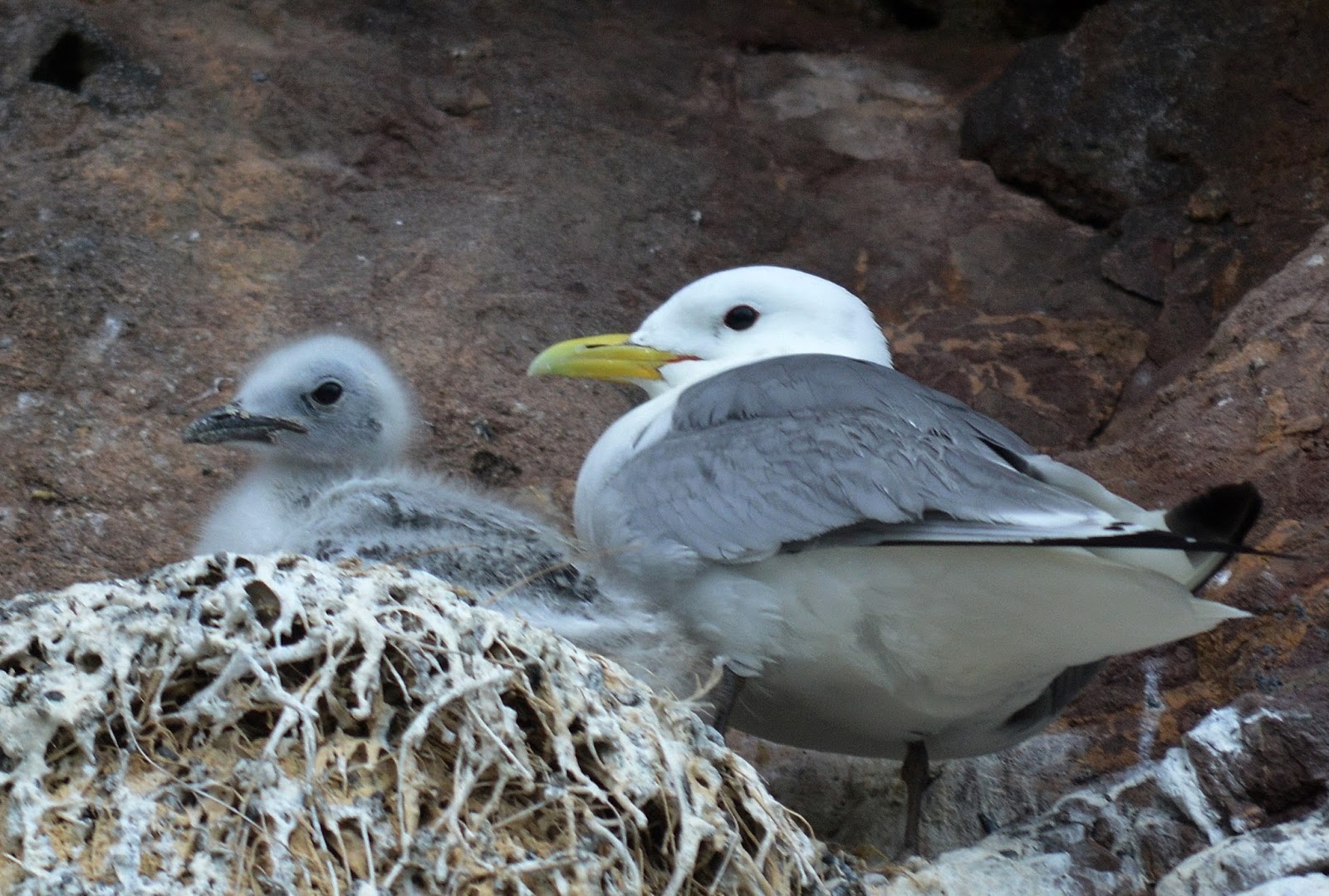
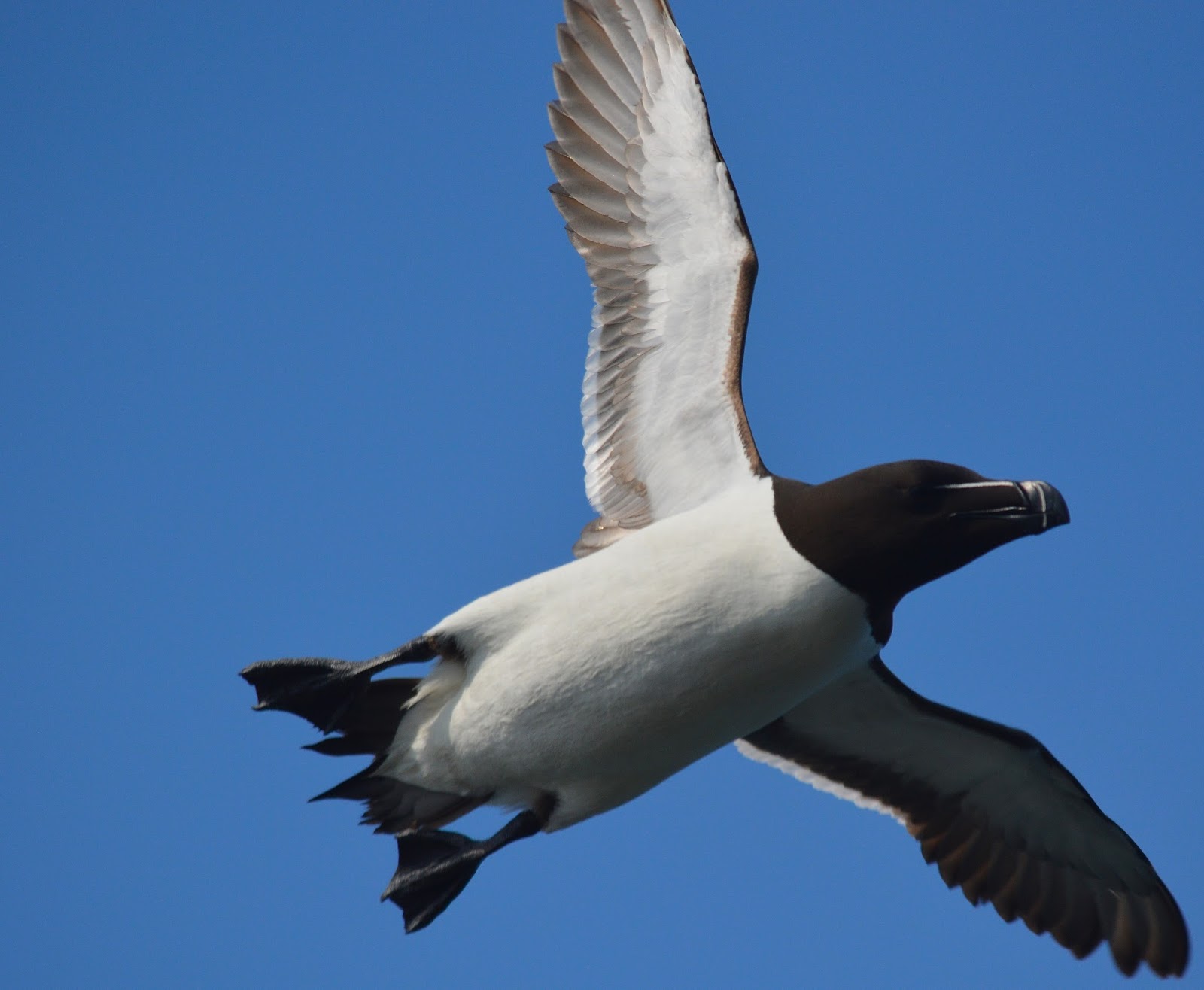
Just before we headed North, I decided to dislodge some cobwebs with an evening paddle round the Ormes. These are North Wales sea-bird cities that, in July, have awk & kittiwake chicks on every towering cliff face. Young guillemots perch on ledges...
...while kittiwake chicks sit in befouled & bedraggled cliff-face nests...
...but razorbill chicks, lodged in crevices, are rarely seen, the adults more skilled at keeping young from teetering on edges. I sat at sea reading Waldo Williams as the sun lowered (Williams is a Welsh-language poet whose work, unusually, is available in an excellent parallel-text edition, translations by Tony Conran).
After the drive back to Bham, it was down to the serious business of choosing books & listening for the long Skye drive. Having read lots of non-fiction recently, we decided on a novel - John Burnside's The Summer of Drowning - & selection of poetry: Kathleen Jamie, Iain Crichton Smith & Michael Donaghy. I also thought it about time to give Sorley Maclean (Skye & Raasay's own poet) a proper go. He's been on the wall of my office for years, in a 1980 painting, 'Poets' Pub', by Alexander Moffat:
I ought to love Maclean: he's a luminary of that magical Scottish set - Macdairmid, Macleod, Crichton Smith, Morgan etc etc etc - and in the late 1920s he was taught by an exceptionally eloquent, insightful (& charismatic) scholar of the Metaphysicals, the Edinburgh critic Herbert Grierson. Far more importantly, he's the true hero of the beginnings of Gaelic-language revival. Maclean's own introduction to From Wood to Ridge conjures that world marvellously. Still, I've always found his poetry inaccessible. He wrote in Gaelic & English, making English translations for his Gaelic verse. I struggle to find the music in the English and feel my lack of the Gaelic more intensely than ever when reading his work. Maclean uses Skye's landscape to root & reify what would otherwise be abstract, overwrought emotional conditions:


   But I have seen from the height of the Cuillin
   darting glory and the weakness of sorrow;
   I have seen the gilding light of the sun
   and the black rotting fen;
   I know the sharp bitterness of the spirit
   better than the swift joy of the heart

Not just the affects Maclean attached to Britain's youngest & most dramatic mountain range (the jagged gabro Cuillin), but also the brutal history of Skye, looms large in his verse. He described an island ravaged by the clearances, left like a gull corpse prostrate in the Minch: 'Pity the eye that sees on the ocean/the great dead bird of Scotland'.

With books & boats packed for the prostrate gull, Llinos & I set off North: 
Nine hours later, we headed into tiny Tokavaig bay, on the first of four peninsulas we'd explore. This was Sleat (Skye’s southernmost leg):
Two otters swam by as we put the boats on the sea, and minutes later exceptionally tiny seals slid into the water from nearby skerries. 
Several others were asleep, nostrils barely protruding from the water, looking for all the world like little smooth round rocks – we kept our distance. As we skirted the coast southwards, Maclean's Cuillin moved in and out of heavy cloud, embodying all the sublime menace that his poems promised:
Gulls cackled as we passed...
 
…while buzzards patrolled the low cliffs to the East...
...and huge views gradually opened up to the West.
This was just a taste of things to come, before we made for the Ardvasar Hotel, a late dinner and a few beers in honour of the Skye festival ceilidh (we were in time to join in the drinking but, to my relief, just too late for dancing).

Long hours of sunlight - and the desire to be on the sea each sunset - allowed us a lazy morning next day. We drove to Carbost and, looking out on the Cuillin, ate oysters a hundred yards from where they'd grown; then we headed downhill to buy a bottle of 'distillery only' Talisker & some new dram glasses, enveloped in the musty pungency of distiller's malt.


This was the prelude to our second journey, out of Loch Bracadale, along the cliff-rimmed promontory of the Harlosh peninsula & round the islands of Tarner, Harlosh & Wiay. Again, but for a bit of chop on the 2km Wiay crossing, conditions were ideal. The islands offered unusual cuillin views, featuring that great nostalgic pleasure to be found in viewing ridges & peaks trodden years earlier & not seen since.
The sheltered side of Tarner was full of seabirds, seals & even this odd little mink that seemed to want to investigate the kayaks.
Wiay was riddled with rock features, including caves, arches & gorges like these:


We’d started on the E side then skirted S; only as we reached the cliffs on the W did the full spectacle of the island open up. Views took in Rum & Canna to the S, the full stretch of the Outer Hebrides to the W & sea stacks (Macleod's Maidens) to the N. 
There were huge cliffs, caves & arches on the island itself, so this was the perfect scene for Llinos to indulge all her ‘play the waves’ proclivities. (I kept a respectful distance, half looking for whales, half resisting the usual nervousness at the way she was bouncing off rocks at nightfall many miles from shore or aid; in my bigger, clumsier, boat I’d be unlikely to offer effective help). Here she is fighting her way out of a swell-filled sea cave, then playing in 'wave school':
With the wonderful western cliffs behind us, it was time to round our final corner...
...& return to Skye as the light faded. While we headed in, the first fishing boat we'd seen all day passed picturesquely in front of Clisham (Harris):
We were back very late, & next morning, since Llinos wasn’t averse to the idea of a lie-in, I decided to nip up Bla Bheinn (the Blue Mountain) before our afternoon kayak. This is a wonderful series of peaks, a ‘great dim sea of gabro waves’ (quoting Maclean again) that presents a high, apparently unassailable wall of dark rock to southern Skye. As Thomas Pennant put it on a visit to the island in the 1770s, 'The prospect to the west was that of desolation itself; a savage series of rude mountains, discoloured, black and red, as if by the rage of fire. The serrated tops of Blaven affect with astonishment: and beyond them, the clustered height of Quillin'.
It is, however, a joy of an ascent. Apart from a few short fields of steep scree, the terrain is excellent and the views – first of trees, waterfalls on Allt na Dunaiche, orchids & dragonflies...
...then, once out of Coire Uaigneich (the secret corrie), of the small isles, Knoydart & SW Skye...
 – are achingly beautiful. The peak was still veiled in cloud as I made it onto the penultimate shoulder (cloud thick enough to soak clothes through while in it) but as I neared the top it cleared, revealing mountain views even more imposing than those during the ascent:
These were vistas that fit Sorley Maclean's descriptions, even if the weather (thankfully) didn't:

   Reaching the blade-back of Bruach na Frithe
   I came in sight of the savageness of the country:
   a heavy black-red mantle of the clouds,
   the storm winds in their mouths;
   about the girdling summits of the awesome scurrs
   a dun opening in the firmament
   under the low red-black dense pall
   of brindled dark surly clouds,
   congregation of the horrors of the elements
   gathering of the storms for exercise;
   hurricane clangour of every blast
   about the grim savage pinnacles;
   shaking and quivering of the yelling blast
   about the battlements of every grey bare-swept summit. 
This peak also gives an unusually extensive view of the red-cuillin pudding lumps:
I figured I could afford ninety minutes at the top, to eat a very early lunch, read some Kathleen Jamie & just take in the spectacle of black & red cuillins, Raasay, Rona, Rum, Eigg & Skye’s majestic sweep:
I wondered whether the pleasure I felt in turning from Maclean to Jamie's precise & musical lyrics was symptom of the golden age of poetry I'm convinced we're living through. A little too long at the top left me needing a knee-breaking jogged descent: luckily, scree is much more fun to slide down than to wade up. Given the stature of this peak I was unsurprised to find this webpage featuring dozens of 20thC postcards of the mountain: http://www.blaven.com/postcards.aspx#

Llinos had been planning while I was away. We'd head north again, have an early dinner at Loch Bay restaurant in Stein and then skirt the southern side of the Waternish peninsula to visit the islands of Isay, Mingay & Clett. These are beatiful islets with a bloody history of inheritances contested through cut throats. Loch Bay was a wonderful eatery: just 7 tables, but a menu full of glorious things & an amazing setting in a secluded cove. The fish was so good that despite the three course fixed-price system I felt compelled to order shellfish for desert – they seemed happy enough to indulge me. Two John Dorys & a bottle of wine later it was time to heed Kathleen Jamie:

   We really ought to rouse ourselves
   to greet some weather - 
   now westlin' winds, now shrouded bens
   now a sklent of sunlight to the heart.

So we pushed off from a jetty 20 metres from the restaurant door, shirt swapped for wetsuit, in perfect evening light.
Half an hour’s paddle later we were at our first island, looking out to the Outer Hebrides once more. Apart from the usual seal convoy, a few black guillemots & a flock of geese rising from Clett, we hadn’t seen much wildlife during the first part of the evening. But while I stayed looking out across the Minch, Llinos had headed round Clett. When she returned, she had an otter to report: she’d watched it catch a fish & just float there eating, staring her down. I made my way round without any real hope of a similar encounter. The otter was standing on a boulder against the skyline – a perfect pose - and I was furious with myself that raising the camera clumsily caused the beast to scuttle into the sea (‘that’s it’, I thought: ‘no more otter tonight’). But it gradually dawned on me that some of the squeaking coming from the rocks was distinct from the screams of fulmar, kittiwake & cormorant that came from higher up the cliff. Scanning the shore for the source of the sound, two small heads could be seen bobbing among the rocks. Suddenly, another adult otter ran down from boulders, at the same moment as the first emerged from the sea. The family then just went about their business acting as though no human was there except for the occasional kayakwards glance.

The otters were at the base of the cliffs on the left of this pic (beneath sklent of sunlight), the outer Hebrides as their backdrop & Waternish on the right: 
The sun had set by the time we turned towards the mainland...
...& paddled across perfectly flat water back into the bay, making for the lights of Stein’s fine pub. This had been quite a day (such a long one that we found ourselves locked out of our hotel!)

The next day's plans were slightly different. We wanted to head to the Trotternish peninsula, under the dramatic cliffs N of Staffin & up to the most northerly corner of Skye.
 (This is where I once spent a blissful camp with Matt Pritchard & Luke Taylor, sitting in the sun, watching rain wash across Lewis & Harris while a basking shark & minke whales fed in the foreground.) But the perfect weather was set to break, with winds rising all afternoon and storms arriving at sunset: our crepuscular habit had to be broken.
This stretch of coast is full of caves, stacks & arches. 
And it's stunning. Under the rolling basalt escarpment of the Trotternish ridge...
...with the western isles looking surprisingly close, this stretch of sea also provides views across the west-coast mainland from Torridon to Suilven & Quinag. But it's the more immediate landscapes that are most beguiling:
The sea here is also wild enough to offer habitat for seabirds we hadn't seen so far: arctic skuas chasing gulls (although nasty, these birds are exceptionally beautiful: unbelievably elegant & agile as they force terns & kittiwakes to vomit up their hard-earned meals); black throated divers & shearwaters were crossing to Rona, while hundreds of razorbills, guillemots & terns also treated the Clarach (the sound between Skye & Raasay/Rona) as a highway.
Unusually (I suspect), the sea beneath the cliffs was perfectly placid, allowing entry to long & winding caves that must often be rendered inaccessible by swell. 
But we knew wind was coming so had to be quick. Here's the very top of the island: the only place where care had to be taken with tides. 
Between Eilean Trodday (right) & Rucha na h'Aiseig (left) tidal streams run fast & even in the best weather, the surface of the sea roars with confused water. It's perfect whale spotting territory, but none today. We were back at the car by 4 o'clock, ready for a more indulgent evening. This began with exceptionally good coffee at a small arts cafe  just a few hundred yards from where we'd parked the car. With perfect views over the sound, and friendly owners who were considering buying a kayak for the local community, Single Track Cafe (www.facebook.com/singletrackskye) is a great place to stop.

Then back south. We stopped off at Seumas Bar in Sligachan (a place of many happy memories). It's situated in this scenic spot:
A pint from the bar's microbrewery, a Talisker Port Ruigh & an Octomore later (I wasn't driving!), we were ready for our last seafood fix before heading south. The weather had now well & truly turned: all the wildness from this point on, including an almost-tragic encounter with a pine marten on the Glen Garry road, was from the comfort of the car. Given that we only had three full days on the island, the week's weather had permitted us to do far more than a fleeting visit to Skye usually allows. It's also been great to see that one of our favourite artists, Shazia Mahmood, has been painting spots very close to where we've been while we were away: http://www.shaziamahmood.com/news/ It's worth following her twitter feed: @ShaziaPaintings (on that note - between this trip & the last I started my own twitter feed: @david_gange - please consider following that too!).